New HPE Curriculum Links for School Camps in Victoria
Planning your next school camp in Victoria just got even easier.
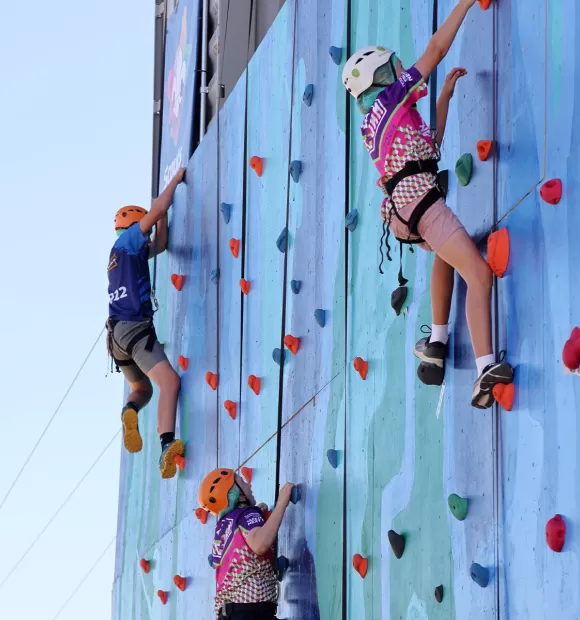
This page maps the Climbing activity to the Australian Curriculum: Health and Physical Education (HPE). Teachers can print or save it as a PDF for lesson planning.
Activity: Climbing (artificial wall or natural rock surface) delivered by Scout Adventures instructors.
Mapped for Years 5–6 and Years 7–8. Suitable for school outdoor education and adventure programs.
| Curriculum content description (HPE) | How the activity links | Sample session feature |
|---|---|---|
| Practise and apply specialised movement skills in a variety of situations (v9: AC9HP6M04) | Students practise climbing movements—handholds, footwork, balance—and apply these to routes of increasing complexity. | Progressive climbs; instructor feedback on efficiency and control. |
| Investigate and apply movement concepts related to effort, space, time, objects and people (v9: AC9HP6M03) | Students plan routes and pacing, applying strength and balance to navigate efficiently and safely. | Timed climbs; planning hold selection before ascent. |
| Demonstrate ethical behaviour and fair play that aligns with rules (v8.4: ACPMP069) | Students take turns belaying and climbing responsibly, demonstrating respect, trust and clear communication. | Belay partner rotation; team debrief on safety and fairness. |
| Apply critical and creative thinking to generate and assess solutions to movement challenges (v8.4: ACPMP068) | Students analyse movement choices to overcome obstacles, refining their approach based on experience and feedback. | Problem-solving routes with limited holds; peer advice rounds. |
| Curriculum content description (HPE) | How the activity links | Sample session feature |
|---|---|---|
| Analyse and refine movement skills in a variety of movement situations (v9: AC9HP8M01) | Students analyse climbing movements and refine technique for efficiency and control using instructor or peer feedback. | Video or peer analysis; improving grip, foot placement and pacing. |
| Demonstrate and explain how movement concepts (effort, space, time, objects, people) can be manipulated to improve outcomes (v9: AC9HP8M03) | Students explore movement variations—reach, rest points, and momentum—to improve their climb strategy. | Efficiency drills; timed or endurance climbs. |
| Plan and implement strategies for connecting to natural and built environments to promote health and wellbeing (v9) | Students reflect on how climbing (indoor or outdoor) promotes resilience, wellbeing and lifelong physical activity. | Post-activity reflection: physical and mental health benefits of climbing. |
| Select, use and refine strategies to support inclusion, fair play and collaboration (Achievement standard link) | Students support peers, belay responsibly, and encourage inclusivity regardless of skill level. | Paired belay teams; discussion on inclusive participation and encouragement. |
Before the activity: Brief students on safety, equipment, harnesses, helmets and belay systems. Emphasise trust and communication.
During the activity: Rotate roles between climber and belayer, encourage positive feedback, and introduce progressive route challenges.
After the activity: Reflect on physical effort, risk awareness, goal setting and how perseverance contributes to wellbeing.
This activity supports both the Movement & Physical Activity and Personal, Social & Community Health strands for Years 5–8.
Need this page as a PDF or curriculum alignment for another activity? Email enquiries@scoutadventures.com.au.